
Exploring a Rust runtime for Bref
Bref runs PHP applications on AWS Lambda. Its runtime is the code that receives AWS Lambda events and passes them to your application, and it is written in PHP. While working on Bref v4, I wanted to know if rewriting it in Rust would make things faster.
The answer is no, because the PHP code in Bref takes almost no time. This article is based on my notes from that experiment.
What Bref does on every request
When an HTTP request reaches a PHP application on AWS Lambda, Bref:
- fetches the event from the AWS Lambda runtime API
- converts the event into a FastCGI request
- sends it to PHP-FPM, which runs the application
- converts the response to JSON and sends it back to AWS Lambda
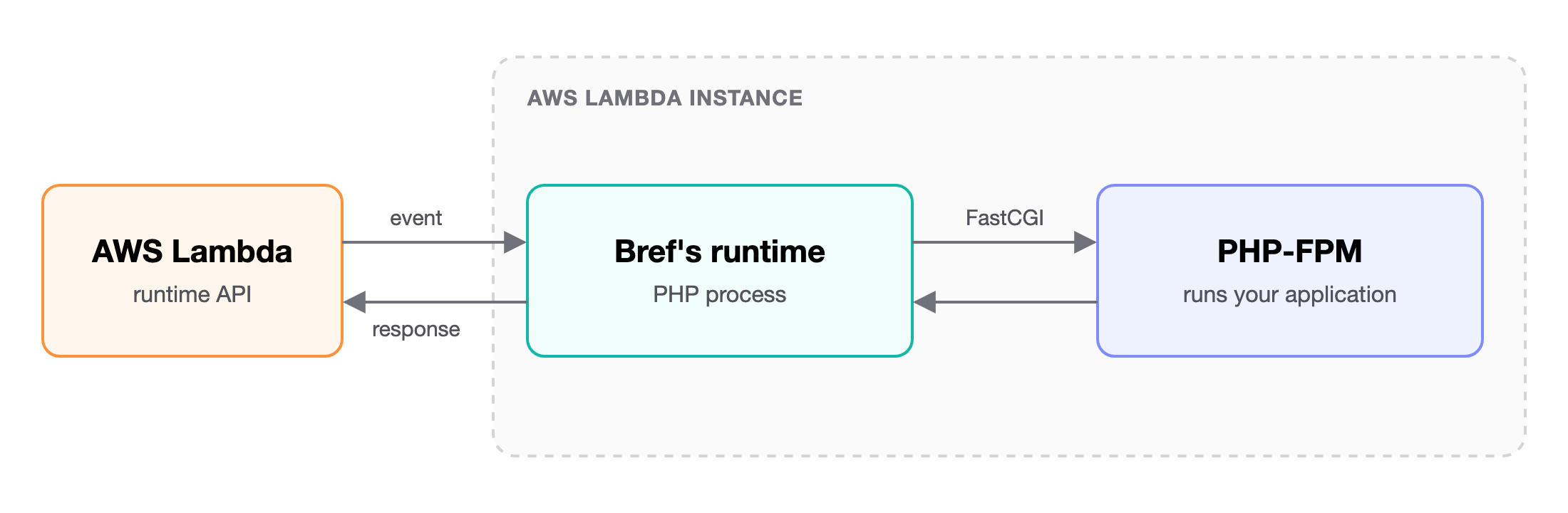
All of that is PHP code running in a PHP process next to PHP-FPM. With Laravel Octane there is no PHP-FPM: Bref's code calls Laravel directly, in the same process.
That's a lot of PHP between AWS Lambda and the application, so I tried two things:
- a PHP extension written in Rust (with ext-php-rs) that replaces the part of Bref that fetches events, decodes them and sends responses
- a single Rust binary that embeds PHP and replaces both Bref's PHP code and PHP-FPM, a bit like FrankenPHP does with Go
I tested both on AWS Lambda (ARM, 1024 MB, PHP 8.5) with a "hello world" application and a Laravel application.
Measuring first
Before writing any Rust, I added timers in Bref to see what takes time. Here is a warm Laravel request with PHP-FPM, 5.9 ms in total:
- 4.65 ms: Laravel
- 0.54 ms: sending the response to AWS Lambda
- 0.36 ms: FastCGI and PHP-FPM overhead
- 0.35 ms: Bref's PHP code, half of which is
json_encode()on the HTML response
On a "hello world" function (no HTTP), Bref's PHP code takes 0.06 ms per invocation.
So there isn't much to optimize. Even if Rust made Bref's code take zero time, a Laravel request would go from 5.9 ms to 5.6 ms.
It's the same for cold starts: Bref's PHP code takes about 9 ms, while starting PHP-FPM takes 80 ms.
I still built the two prototypes to check.
The Rust extension
The extension replaces the loop that calls the AWS Lambda runtime API. The HTTP calls are done in Rust instead of using curl in PHP.
Results:
- cold starts: no difference
- warm invocations: about 0.3 ms faster
0.3 ms is a third of a "hello world" invocation, but less than 10% of a Laravel Octane request. And to get that, Bref would need to provide a compiled extension for every PHP version and CPU architecture.
That's not worth it.
Replacing PHP-FPM
The second prototype is a bigger change. One Rust binary contains PHP itself (linked statically). It calls the AWS Lambda runtime API and runs the PHP application in the same process. There is no PHP-FPM, no FastCGI, and no PHP code at all in the runtime.
It behaves like PHP-FPM: every request starts from scratch and nothing is kept in memory between requests. So this compares the same thing, with and without PHP-FPM.
This time there is a difference:
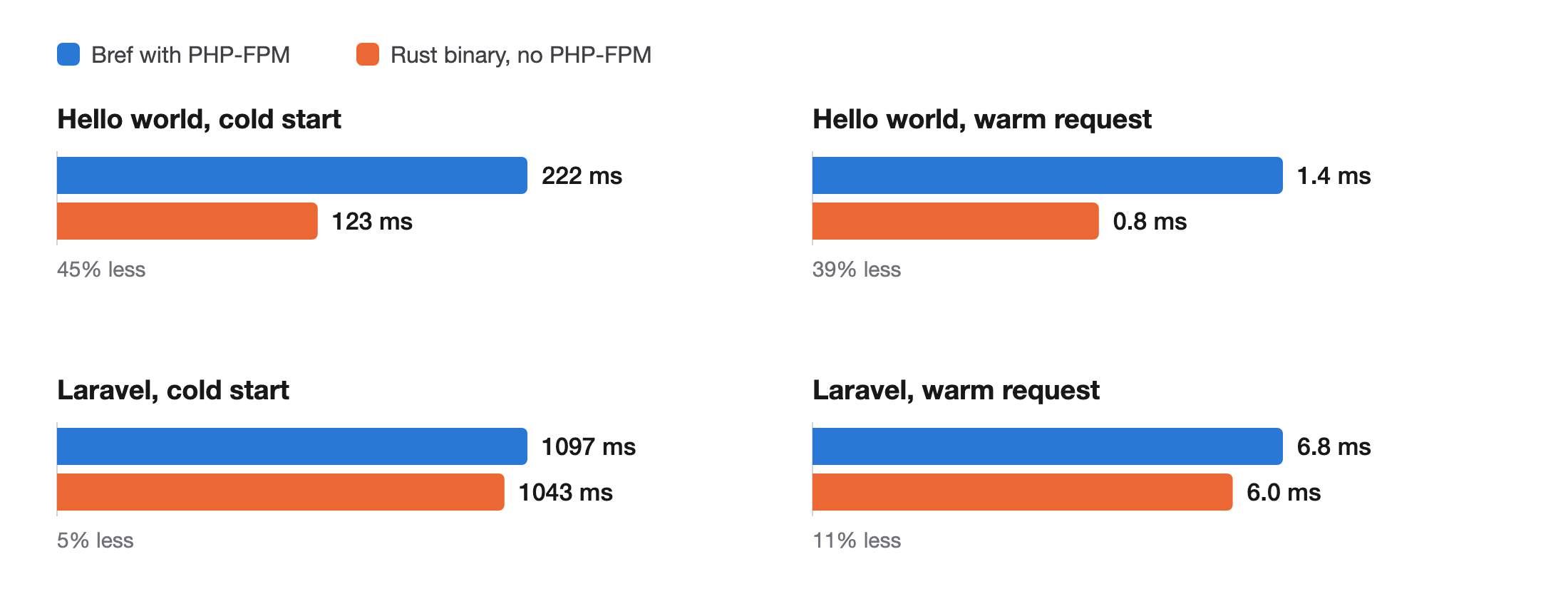
| Cold start | Warm request | |
|---|---|---|
| Hello world, Bref with PHP-FPM | 222 ms | 1.4 ms |
| Hello world, Rust binary | 123 ms | 0.8 ms |
| Laravel, Bref with PHP-FPM | 1097 ms | 6.8 ms |
| Laravel, Rust binary | 1043 ms | 6.0 ms |
Note: Bref v4 will make Laravel cold starts much shorter, but that is not included in this benchmark.
100 ms less on a "hello world" cold start is nice. But with Laravel that's only 5% on cold starts and 11% on warm requests, because most of the time is spent in Laravel.
Also, this gain is not really because of Rust. It's faster because there is no PHP-FPM process anymore.
So where do these 100 ms come from? On a cold start, Bref starts two programs: php (which runs Bref's code), then php-fpm. They are two separate files of about 25 MB that contain almost the same code, and AWS Lambda has to load both from disk. Most of the 100 ms is spent loading the second one.
There is a simpler way to avoid that: compile php and php-fpm into a single binary. I proposed that change to PHP and I benchmarked it a few weeks ago (on x86 that time): the "hello world" cold start went from 280 ms to 211 ms. The same application without PHP-FPM at all starts in 195 ms. So a single binary gives most of the gain, and we keep PHP-FPM.
And keeping PHP-FPM is a good thing. It parses requests, handles file uploads and timeouts, and when a request crashes the next one still works. Without PHP-FPM, Bref would have to do all of that. The prototype also needed some C code to work with PHP's internals (PHP uses longjmp for fatal errors, and that doesn't work well with Rust).
What about Octane?
With Laravel Octane, Bref keeps Laravel in memory between requests, so there is no PHP-FPM to remove. I tried three variants:
- the Rust extension
- the Rust binary running Bref's Octane handler
- the Rust binary filling
$_GET,$_POSTand$_SERVERitself, like FrankenPHP does
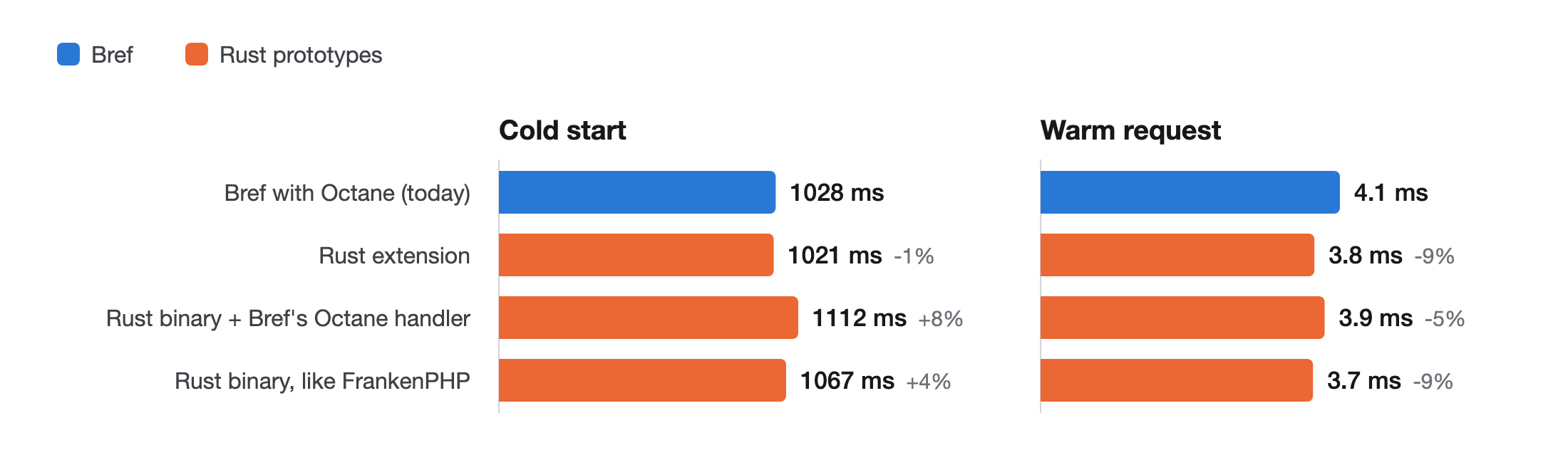
All three give about the same result: 0.2 to 0.4 ms faster on a request that takes 3 to 4 ms. With the Rust binary, cold starts were also 40 to 80 ms slower. I didn't investigate why.
Three different CPUs
At some point the Rust extension was 1 ms slower than Bref on Laravel. That made no sense.
It turns out AWS Lambda on ARM (in the Paris region at least) runs functions on three generations of Graviton CPUs. You don't choose which one you get, and it can change every time a new Lambda instance starts. The same Laravel request took:
- 5.0 to 5.6 ms on Graviton2
- 3.7 to 4.2 ms on Graviton3
- 3.1 to 3.3 ms on Graviton4
The extension was running on a Graviton2 and Bref on a Graviton3, so I was comparing the CPUs more than the code.
If you benchmark on AWS Lambda with ARM, log the CPU model (it's in /proc/cpuinfo) and compare results on the same CPU. All the numbers in this article are from Graviton3.
Conclusion
Bref's runtime will stay in PHP in Bref v4.
A few hundred lines of PHP run on every request and they cost less than half a millisecond. PHP is just that fast, I can't complain about it :)
I'm glad I added the timers before anything else, because they already showed what the prototypes confirmed later.
If you want faster cold starts with Laravel, optimize the application instead of the runtime: caching the config and the opcode cache before deploying gives much better results.
Bref v4 will come with many other performance optimizations, stay tuned for the release.